
This article was originally written for HR & Ledelse (danskhr.dk).
Trust between leadership layers can erode before senior leaders realize there is a problem. To spot it early, look at trust scores by leadership layer and make room for regular dialogue with the managers who must translate decisions into action. If trust is falling, ask what they have not been involved in or equipped to explain before defending the decisions already made.
In my work with organizations, I have seen this happen at different points in the leadership chain. In the two anonymized cases below, the extended leadership team was left out of a strategic process in one organization, while people managers lacked the information they needed in another. Both show why rebuilding trust requires senior leadership to take responsibility for the gap.
Jump to:
- Why Do Organizations Often Spot a Breakdown in Trust Too Late?
- Why Does Senior Leadership Defend Itself When It Should Ask Questions
- When the Executive Team Leaves the Extended Leadership Team Out
- When People Managers Lack Answers for Employees
- Why Senior Leadership Must Own the Trust Gap
- How to Respond When Trust Falls Between Leadership Layers
Why Do Organizations Often Spot a Breakdown in Trust Too Late?
When do we know that trust in the organization has hit a critical low? Unfortunately, the answer is usually: far too late. This isn't because of poor judgment or a lack of interest in employees and managers. But more and more executive teams and senior leaders find that their organization has suddenly, and often without warning, experienced a breakdown in trust: a break between leadership layers.
These breaks can damage both the business and employee wellbeing if they aren't caught in time and taken seriously. So what should you be listening for, and how do you handle a breakdown in trust between layers of the hierarchy?
The surprise is often considerable when this year's employee wellbeing survey shows that people managers suddenly score low on trust in senior leadership. Why didn't anyone say anything? The surprise is even greater when the data shows that the organization's own leadership team is losing trust in senior leadership's strategy, communication, and decisions. We're seeing this pattern in far more organizations than before.
It's good to finally see the problem in black and white. But I'd argue you can catch this far earlier and avoid the deep trust gap altogether.
Why Does Senior Leadership Defend Itself When It Should Ask Questions?
Senior leaders are famous for being adaptable and decisive. That's a real strength in times of crisis, uncertainty, and fast-moving markets. But what I've encountered more and more often are poor excuses. Not because the executive team doesn't want to change course, but because defending the decision becomes the easier and faster response when uncertainty, pace, and complexity all rise.
Being defensive is rarely the solution: "We're in the middle of implementing a new strategy," or "Market uncertainty is extremely high right now." Both are good arguments. But when trust is already broken and senior leadership has stopped prioritizing listening to and understanding the organization, that same strategy, market uncertainty, and faster pace of work can end up making things worse.
But how do you actually rebuild that trust in practice?
My typical recommendation: respond to the data with dialogue, not explanations.
When the data shows falling trust at a leadership layer, the first step shouldn't be to explain or defend decisions. It should be to invite structured dialogue. The goal is to understand the assumptions, concerns, and perceived breaches behind the numbers, not to correct them.
When the Executive Team Leaves the Extended Leadership Team Out
Organization XY needs to develop a new, more flexible strategy, one where AI is a requirement, not an option. That takes serious time and effort from the executive team, work every member throws themselves into with real energy and enthusiasm. But the challenges appear the moment the strategy needs to be implemented. That becomes painfully clear to me, because I'm set to present this year's engagement survey results the same month the strategy is unveiled to the organization.
A breakdown in trust, and a break at the very first level of the organization. The executive team is genuinely proud of both their work and their communication around the new strategy. But what becomes very clear is that they've forgotten to involve, inform, and communicate with their next layer of leaders: the extended leadership team. Those leaders weren't included in the decisions, so they'll struggle to stand behind the new strategy. They weren't briefed before the rest of the organization, so they'll struggle to translate it into real actions and behavior changes further down. And they generally struggle to see the reasoning behind decisions the executive team made along the way, which is exactly why trust has taken such a serious hit.
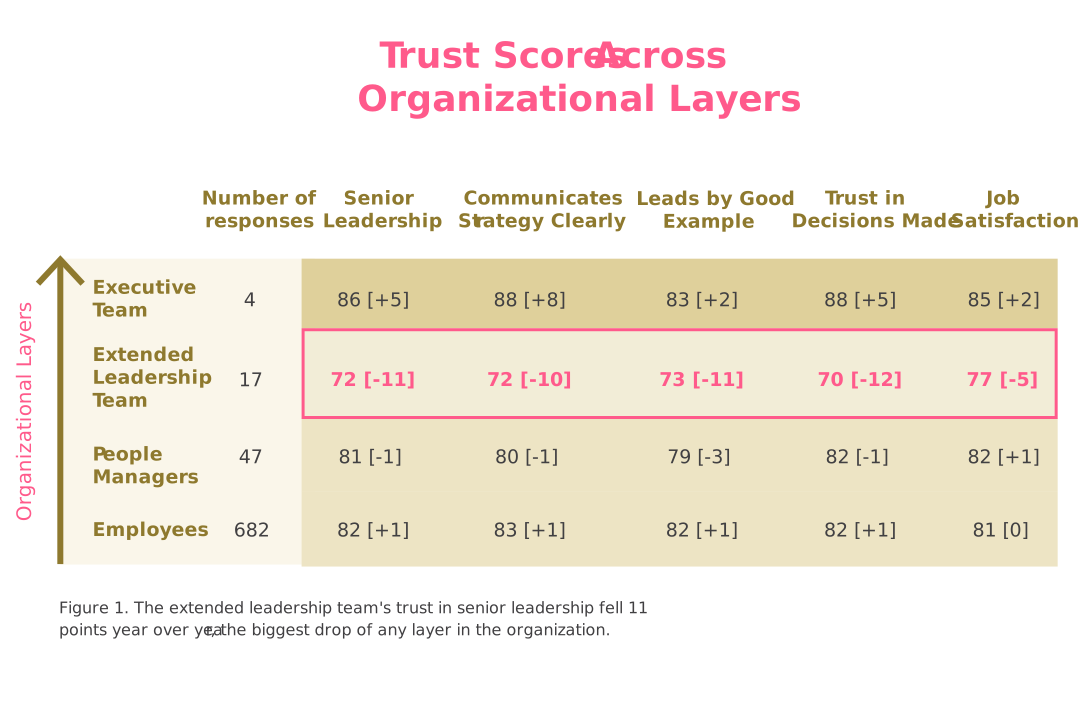
When trust is under pressure, senior leadership should deliberately practice asking open,
exploratory questions of their leaders, rather than quickly defending decisions. Questions like "What makes this strategy hard to stand behind?" or "What have we underestimated in the implementation?" can rebuild trust far faster than another round of rational explanations.
Beyond that, involve the next leadership layer before the decision is finalized. Extended leadership teams should be brought into strategic processes early, not to make the decision, but to challenge it, understand it, and build ownership. When leaders can recognize their own questions and concerns in the final strategy, they're far better equipped to translate it credibly to the rest of the organization.
When People Managers Lack Answers for Employees
Organization AB is grappling with supply security challenges. Global developments have made the market unpredictable, and the company's entire supply commitment is balanced on a knife's edge, since the agreement will have to be made with the US. That could mean expanding the factory and hiring 75 to 100 new production employees. Or it could mean a 35 percent drop in production, making layoffs unavoidable.
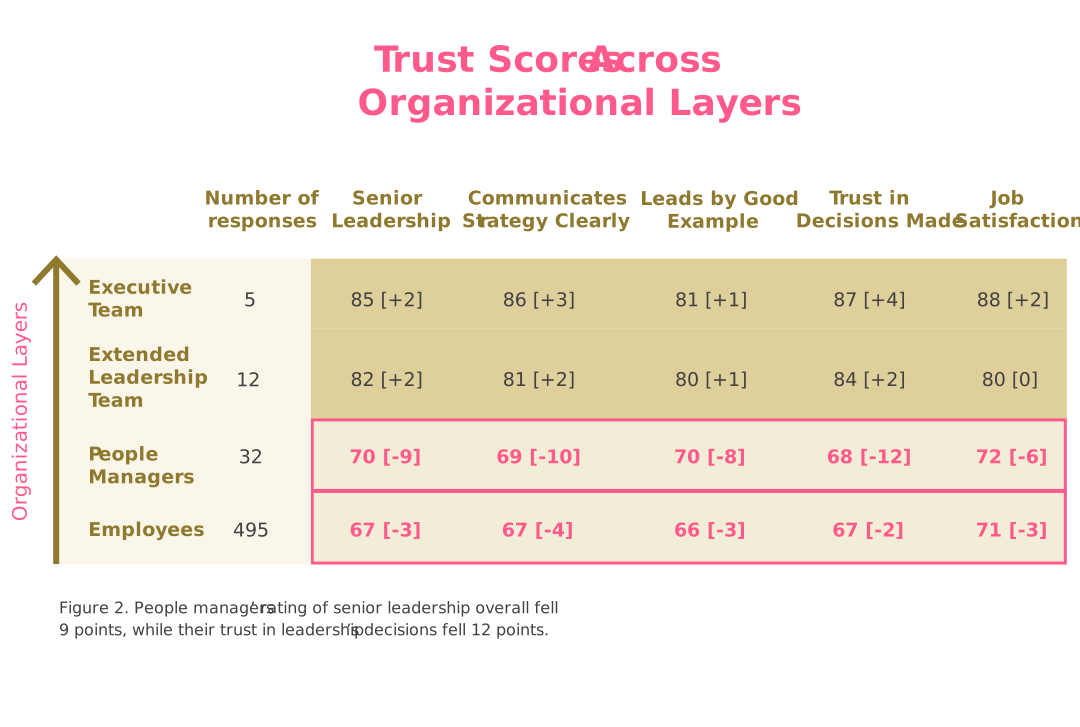
The executive team feels they've communicated as clearly as they can, but as they put it, "we can't tell everyone everything!" The extended leadership team has been briefed on the different scenarios and understands the stakes. The problem is that nobody has invited the people managers into these conversations, so they feel disconnected, deprioritized, and left to fend for themselves. In uncertain times, senior leadership should actively equip people managers with a clear story: what they know, what they don't know yet, and when they can expect more clarity. Silence breeds rumors. Being transparent about uncertainty builds trust.
Employees voice their frustrations to their closest managers, who try to stay loyal upward while lacking the answers their own people need. Everyone knows something is going on, but no one knows what or why.
In this example, people managers get caught in a double loyalty bind, one senior leadership typically misreads as a lack of loyalty upward, especially since those same managers score highly on their own direct leadership scores. That risks widening the trust gap even further, since low scores on senior leadership usually end up becoming the managers' problem to solve, not the executive team's.
Why Senior Leadership Must Own the Trust Gap
My recommendation to an executive team facing this picture, a break in trust at the second layer of the organization, is to try to understand why, and what's driving the behavior of managers at the front line. It's very rare, in my experience with this scenario, to come away with the sense that these managers are working against the strategy or being deliberately disloyal to the direction set. More often, they don't even realize they're expected to do anything differently than before.
Managers feel overlooked and unheard when they try to ask questions. If senior leadership doesn't ensure transparent communication through every layer, making sure the extended leadership team is equipped to translate strategy into concrete day-to-day behavior, then, as in this scenario, employees end up paying the price. They'll be seen as obstructive and resigned because of their constant complaints, complaints that should really be heard as curiosity, as critical but relevant questions. In the end, they're left with a sense of inadequacy and a lack of control.
A drop in trust toward senior leadership should never be treated as an individual management problem belonging to the layers below. It should be treated as a shared, structural issue, one where the executive team actively takes responsibility for rebuilding the relationship and creating mutual understanding.
How to Respond When Trust Falls Between Leadership Layers
Start by comparing trust scores across leadership layers. An overall result may hide a marked decline among the leaders expected to carry decisions into practice. Then invite the affected managers into a structured conversation: Which decisions are difficult to explain? Where were they involved too late? What questions from their teams can they not answer?
Use their answers to decide what senior leadership needs to clarify, where managers should be involved earlier, and when you will report back. Continue the conversation through brief check-ins, and use later survey results to see whether the gap is closing. The executive team must own this follow-up rather than leave individual managers to resolve a problem between leadership layers.
Read more about how to listen to employees more frequently without creating unnecessary survey fatigue.
So the question isn't whether trust is under pressure. It's whether senior leadership can see it, understand it, and act on it, before followership actually breaks down.
About the Examples
The two examples in this article, referred to as Organization XY and Organization AB, are real examples from Rasmus's advisory practice in 2025-2026. Names and other identifying details have been changed to protect their anonymity.

When Leadership Scores Drop, What Comes Next?
Low scores can point to a trust issue. The harder part is understanding why and knowing what to do next. From Low Scores to Leadership Success gives HR practical guidance to support leaders and turn survey results into action.
Engagement surveyTrack Trust Across Leadership Layers
An annual employee survey gives you an important overall picture. Supplementary measurements and regular dialogue within management groups can help you catch early cracks sooner. See how Ennova can help you put together a listening and follow-up setup that fits your organization. |