


Employee Experience: From Feedback to Action
Most organizations already know how to listen to employees
The hard part is knowing what to act on and making sure it actually happens
 Measure employee experience across the employee journey
Identify the moments that matter
Turn feedback into action
Measure employee experience across the employee journey
Identify the moments that matter
Turn feedback into action
What is Employee Experience?
Employee experience (EX) is the sum of how a person experiences your organization across their employee journey.
It shapes how people feel at work, how they perform, and how they grow professionally and personally.
It includes major moments such as onboarding, leadership changes, and career development, as well as the everyday systems, interactions, and decisions that shape how people experience work.
Employee experience isn't owned by HR alone. It reflects how leadership, culture, systems, and daily work come together across the organization.
Employee Experience vs Employee Engagement
Employee experience, employee engagement, and employee satisfaction are often used interchangeably. They're not the same thing, and the difference matters. If you confuse them, you'll measure the wrong things and act on the wrong signals.
The simplest way to understand the difference is to think of employee experience as the input and employee engagement as one of the outputs.
Employee experience is the broader system that shapes how people experience work. Employee engagement is the emotional commitment people feel toward their work and organization. Strong engagement starts with understanding the experiences that shape it.
| Employee satisfaction | Employee engagement | Employee experience | |
| Definition | How content people are with the basics of their job. | The emotional commitment people feel toward their work and organization. | The full picture of how people experience your organization across the journey. |
| Primary focus | Pay, benefits, working conditions, work-life balance. | Motivation, purpose, trust in leadership, and personal growth. | Culture, leadership, systems, and the moments that matter. |
| Key question | "Are our people content enough to stay?" | "Are our people motivated enough to perform?" | "How do our people experience work across the journey?" |
The Employee Journey
The clearest way to understand employee experience is through the employee journey: the path a person takes through your organization from first interaction to exit, and sometimes beyond.
Most organizations think of the journey in four broad stages:
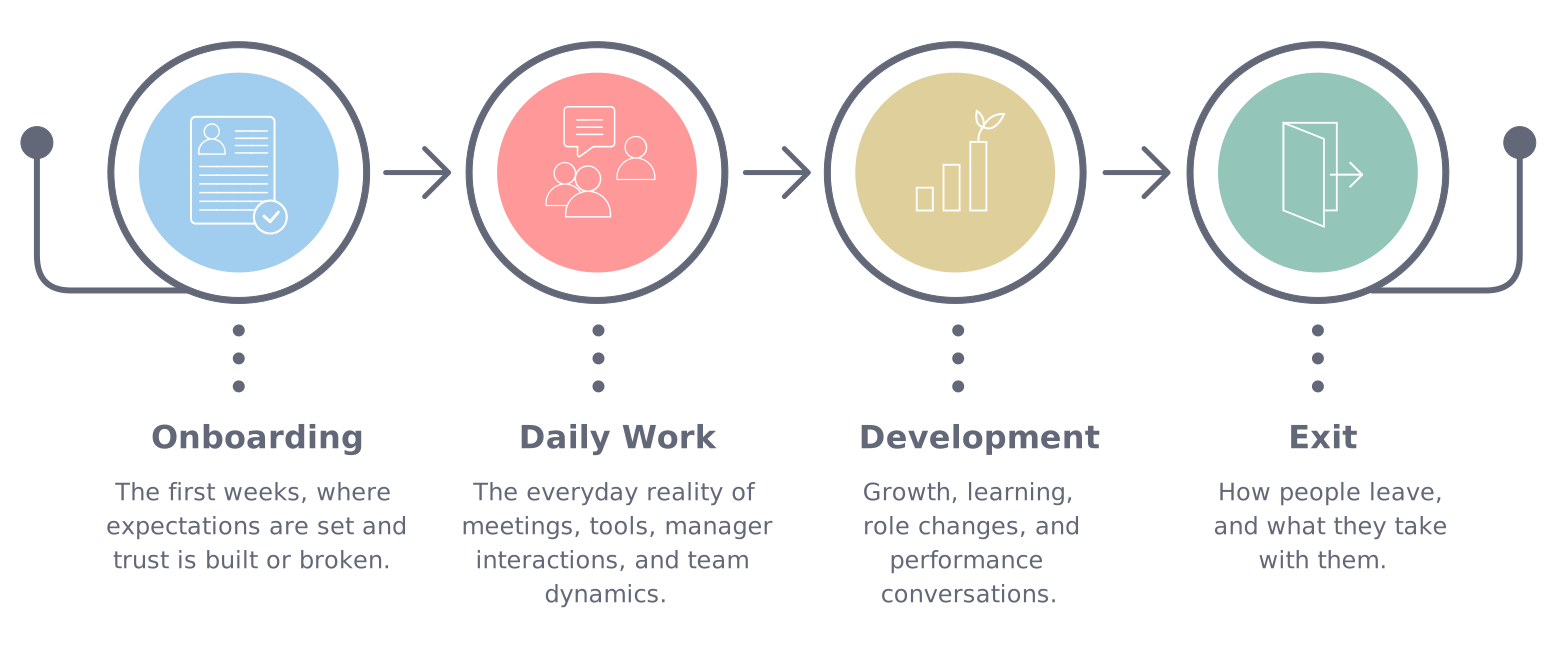
This is also where most organizations struggle. Collecting feedback across the journey is one thing. Knowing which moments to act on, and how, is what actually improves the experience.
The 4 Key Drivers of Employee Experience
Employee experience is shaped by many things, but four drivers do the heavy lifting in most organizations. Get these right, and the rest gets easier. Get them wrong, and even the best perks won't compensate.
- 01 Leadership
- 02 Culture
- 03 Work Environment
- 04 Technology
Employee Experience Driver #1: Leadership
Direction, trust, psychological safety, communication, accountability, and follow-up. Leaders set the tone for what's expected and what's possible. When leadership is clear and consistent, people know where they stand.
When it isn't, people fill the silence with assumptions (usually the worst ones).
Employee Experience Driver #2: Culture
Shared norms, values, collaboration, inclusion, recognition, and ways of working.Culture isn't what's written in the handbook. It's what people see rewarded, what gets ignored, and how decisions are actually made.
Strong culture creates belonging and alignment. Weak culture creates confusion and inconsistency.
Employee Experience Driver #3: Work Environment
The physical, social, and organizational conditions that shape daily work.It includes workload, collaboration, team dynamics, flexibility, and whether people have the support they need to succeed.
Employee Experience Driver #4: Technology
Tools, systems, and digital workflows that support or block employees and managers.The wrong tech can erode experience faster than almost anything else, because it's there every single day.
The right tech does the opposite: it removes friction instead of creating it.
How to Measure Employee Experience
Employee experience is measured across the employee journey, not through a single score. The goal isn't just to collect feedback.
It's to understand where experience is strong, where it breaks down, and where action will have the greatest impact.
Where you Measure
Measure at the moments that matter across the employee journey, including onboarding, manager transitions, development, and exit.
Different moments reveal different challenges, which is why a single annual survey rarely tells the full story.
What you Measure
Use a mix of quantitative metrics and qualitative feedback. Two metrics carry most of the weight in:
- eNPS (Employee Net Promoter Score)
- Engagement Score
Together, they help explain both sentiment and commitment.
How you Measure
Measure consistently enough to compare across teams, regions, and time, but flexibly enough for local managers to act on the results. The strongest EX programs balance shared direction with local ownership. And they treat measurement as a starting point for action, not an end goal.
Where you Measure
Measure at the moments that matter across the employee journey, including onboarding, manager transitions, development, and exit. Different moments reveal different challenges, which is why a single annual survey rarely tells the full story.
What you Measure
Use a mix of quantitative metrics and qualitative feedback. Two metrics carry most of the weight in:
- eNPS (Employee Net Promoter Score)
- Engagement Score
Together, they help explain both sentiment and commitment.
How you Measure
Measure consistently enough to compare across teams, regions, and time, but flexibly enough for local managers to act on the results. The strongest EX programs balance shared direction with local ownership. And they treat measurement as a starting point for action, not an end goal.
Employee Experience Surveys
Surveys are the workhorse of employee experience measurement. They're how organizations capture what people are thinking, what's working, and what isn't. But not all surveys do the same job.
Four Survey Types Form the Foundation of Most Employee Experience Programs:
Engagement surveys
Engagement surveys go deep. They measure motivation, commitment, and the specific drivers that build or block engagement, like leadership, recognition, growth, and trust. Run once or twice a year, they give you the foundational read on where engagement is strong, where it's slipping, and why. An employee engagement survey is the cornerstone of most EX measurement programs.Employee Lifecycle Survey
Employee journey surveys, also called Employee Lifecycle Surveys, capture feedback at key moments, such as onboarding, role changes, manager transitions, and exit.
They complement the Engagement Survey by showing how specific moments shape the overall employee experience and where employees gain or lose momentum.
Pulse Surveys
Pulse surveys are shorter, more frequent check-ins that complement a major Engagement Survey rather than replace it. They track specific themes over time, follow up on lower scores, or take the temperature on a particular initiative.They are particularly useful when you want to see whether the actions taken after a major survey are actually moving the needle.
360 and Leadership Feedback
A Leadership Development Survey captures feedback on leadership behavior from multiple perspectives: direct reports, peers, and managers. It tells you not just whether leaders are perceived as effective, but how their behavior is shaping the experience of the people around them. Since leadership is one of the strongest drivers of EX, this is often where targeted improvement starts.From Feedback to Action
This is the part of employee experience that falls short most often. But it's the part that matters most. Here’s why.
Most organizations know how to collect employee feedback. The challenge is turning insight into action. When nothing changes after a survey, trust erodes, engagement stalls, and future feedback becomes less valuable.
Why Employee Surveys Fail to Drive Change
Surveys rarely fail because of the questions alone. They fail when the follow-up is not designed for action. Across organizations, the same patterns appear again and again:
The Data Lands Without a Plan
Results come back, dashboards light up, but nobody is clear on what should happen next.
Managers get Insight, but not Enough Direction
A score and a heatmap are not enough. Managers need to know where they can make the biggest impact and how to turn feedback into team dialogue and action.
Senior Leaders do not set Clear Priorities
Without clear priorities, every team tries to fix everything and nothing changes.
Local Context Gets Lost
A global score hides the fact that one market, one function, or one team is in a very different situation than the others.
Follow-up Disappears
People share feedback in good faith, hear nothing for six months, and then are asked to share again. The next response rate tells the story.
When these patterns persist, feedback stops driving change and becomes a corporate ritual. That's when trust erodes, participation drops, and the value of listening disappears. Understanding why surveys fail is the first step. The next is creating the structures, ownership, and processes that turn feedback into meaningful change.
What It Takes to Turn Feedback Into Action
Five of Those Conditions Matter Most:
Governance
A clear process for how feedback moves from collection to decision to follow-up. Who reviews what, when, and with which mandate to act. Without governance, even good intentions get lost in calendars.
Ownership
Someone must own what happens next. HR owns the process. Leaders own the priorities. Managers own the dialogue. Without clear ownership, action stalls.Manager Enablement
Managers play a key role in employee experience. They need more than a report: they need a clear understanding of what the data means, where they can make the biggest impact, and how to turn feedback into team dialogue and action.Leadership Accountability
Senior leaders set the tone for whether feedback matters. When they engage with the results, choose priorities, and follow up publicly, the organization listens. When they don't, the rest of the system stalls.Visible Follow-up
People don't expect everything to be solved. They expect to know that they were heard, what's being done, and what they should expect next. Communicating action (even small action) is what rebuilds trust between rounds of feedback.The Shift from Feedback to Action
Most organizations are good at listening. What they struggle with is what happens next.
The strongest employee experience programs make a deliberate shift:
- From reporting on feedback to acting on it
- From measuring engagement to improving it
- From "we ran the survey" to "we changed something because of it"
That's when employee experience stops being an HR exercise and starts becoming a driver of organizational performance.
How Do You Build an Employee Experience Strategy?
Knowing what employee experience is and why it matters is one thing. Building a strategy that changes how people experience work is another.
A strong employee experience strategy is a clear plan for how your organization will measure, improve, and continuously manage employee experience over time.
A Simple Framework for a Strong Employee Experience Strategy
Most successful employee experience strategies follow the same basic logic: understand the current experience, decide where to focus, and create a plan for turning insight into action.
-
Where you are
A clear baseline of how people currently experience the organization, where the strongest moments live, and where the biggest gaps are. -
Where you're going
A small set of priorities that match the business strategy, the cultural ambition, and the organizational realities employees are experiencing right now. Not a list of everything, but the few things that matter most. - How you'll get there
The roadmap, the ownership model, and the rhythm of measurement, action, and follow-up that turn the strategy into something people experience in their daily work.
A Roadmap for the First Year and Beyond
Most organizations don't improve employee experience all at once. Progress happens in phases, starting with understanding the current experience and ending with a continuous cycle of measurement, action, and improvement.
0-3 Months
- Define what EX means for your organization
- Map existing listening channels
- Identify key moments in the employee journey
- Clarify ownership across HR, leadership, and managers
- Run baseline measurement
3-12 Months
- Prioritize the drivers and moments that matter most
- Equip managers to interpret results and have real conversations
- Create local action planning routines
- Build leadership accountability
- Communicate what's happening, so people see feedback leads somewhere
12+ Months
- Connect lifecycle, engagement, pulse, and leadership feedback
- Use benchmarks and trends to keep priorities sharp
- Strengthen governance
- Track progress
- Keep improving the moments that matter
The first phase establishes the baseline. The second turns insight into action. The third creates the routines that keep employee experience improving over time. Employee experience is never "finished". The strongest organizations revisit priorities, track progress, and continuously improve the moments that matter. None of this happens without clear ownership. HR, leaders, managers, and employees all have a role to play.
Who Owns What in an Employee Experience Strategy?
Employee experience can't be owned by one function alone. The strongest EX programs distribute ownership clearly:

HR and the People
HR owns the framework: how feedback is collected, how results are shared, and how managers and leaders are supported to act on them.

Senior Leadership
Owns the strategic priorities and the accountability that makes follow-through possible.

Managers
Managers own the local dialogue: the team conversations and the actions that follow.

Employees
Employees provide honest feedback and contribute to the improvements that follow. Employee experience only improves when people stay engaged in the process.
This is a division of labor, not a hierarchy. When everyone knows their part, EX work moves forward. When ownership is unclear, it stalls (or it falls back on HR alone), which is where most EX strategies quietly fail.
How Ennova Supports Your Strategy
Ennova helps enterprise organizations build employee experience strategies that work across markets, business units, and cultures.
We combine measurement, benchmarking, manager enablement, and advisory support to help organizations turn feedback into action.
We don't run your strategy for you. We help your organization run it better.
Why Ennova:
✓ Closed-loop Employee Impact Platform.
✓ AI-driven insights.
✓ Human expertise.
✓ Structured transformation programs.
How Do You Improve Employee Experience?
Improving employee experience isn't about adding more programs. Most organizations already have plenty of those. Instead, the goal is to do fewer things better, in the places where it actually counts.
Four Principles Guide the Strongest Improvement Work:
Identify the Real Problem Before Solving it
Equip Managers to act on Feedback
Improve the Moments with the Highest Impact
Remove Barriers that Make Work Harder
Employees don't expect every issue to be solved. They expect visibility, progress, and communication. That's what turns feedback into improvement and makes future feedback worth giving.
What is an Employee Experience Platform?
An Employee Experience Platform is the system that holds the whole thing together. It collects feedback across the employee journey, turns it into insight and helps HR, leaders, and managers turn insight into action.
A survey tool gives you a questionnaire and a dashboard. Enterprise employee experience platforms do more than collect feedback. They support continuous listening, prioritization, action, and follow-through across the full employee journey.
Put simply: a survey tells you something. A platform (whether you call it an EX platform or an employee feedback platform) helps you do something about
What to Look for in an Employee Experience Platform
Not every platform fits every organization, and not all employee experience tools are built for enterprise scale.
But the strongest setups share a few qualities:
Coverage across the journey
The strongest employee experience solutions cover the full lifecycle, not just an annual engagement survey: onboarding, pulse, leadership feedback, exit, and the moments in between
Insight that managers can actually use
Clear team-level views, smart recommendations, and the ability to filter data by team, market, or function without needing a data analyst.
Built for action, not just reporting
Tools that support action planning, follow-up, and visible communication after feedback, not just a dashboard that lights up once a year.
Enterprise-ready
The security, compliance, accessibility, and integrations that make it fit into the rest of your organization (Workday, SAP, Azure AD, and the like). For most large organizations, certifications like ISO 27001, SOC 2, GDPR, and WCAG 2.2 are non-negotiable.
Thoughtful use of AI
AI should help people work faster and smarter without replacing human judgement or creating a black box. At Ennova, we use Thoughtful AI to support text analysis, smart recommendations, and trend detection with transparency about how the technology works.
Ennova’s People Impact Platform
Ennova's People Impact Platform is built for exactly this. It is EX software that supports the full employee journey, from engagement and pulse tolifecycle and leadership feedback. It's designed to give managers usable insight, not just data. It includes the AI, analytics, integrations, and security that enterprise organizations require. And it's backed by 30+ years of EX experience, global benchmarks, and the advisory and follow-through that turn measurement into change.
Because the platform isn't the point. What people experience at work is.
The strongest organizations do not just measure employee experience. They measure it across the journey, focus on the moments that matter, and turn feedback into action that changes how work feels. That is what Ennova helps enterprise organizations do.
FAQ About Employee Experience
Employee experience (EX) is the sum of how a person experiences your organization across their working life: Every interaction, decision, system, and moment from the day they first hear of you to the day they leave. It includes the big things, like a promotion or a new manager, and the small things, like whether the right tools work on a Monday morning.
Employee experience directly shapes retention, engagement, performance, culture, customer experience, and innovation. Strong EX leads to measurable business gains. Weak EX leads to costly turnover, reduced performance, and a weakened employer brand. Most of those costs don't show up on a single line in a budget.
Employee experience is the broader system: the culture, leadership, processes, and daily moments that shape work. Employee engagement is one of the most important outputs of that system: the emotional commitment people develop when their experience is strong. EX is the input. Engagement is one output.
The employee journey is the path a person takes through your organization, from first hearing about you to leaving (and sometimes beyond). It includes broad stages like onboarding, daily work, development, and exit, with dozens of subjourneys and hundreds of touchpoints inside them. The most important touchpoints are called "moments that matter”.
The most critical touchpoints include recruitment, onboarding, the first weeks with a new manager, development conversations, role changes, promotions, performance reviews, returns from leave, and exit. Each is a "moment that matters": a point where people form lasting impressions about whether the organization is a place worth investing in.
Four drivers do most of the heavy lifting in employee experience: leadership (direction, trust, communication), culture (norms, values, recognition, ways of working), work environment (physical, social, and organizational conditions), and technology (tools, systems, and digital friction). These drivers reinforce each other, improving one alone rarely creates lasting change.
Psychological safety (the feeling of being able to speak up, raise concerns, and share ideas without fear) is a foundational element of strong employee experience. It influences trust in leadership, team collaboration, innovation, and belonging. When it's missing, people disengage quietly long before they leave. When it's present, the rest of the EX system can actually work.
eNPS, or Employee Net Promoter Score, measures whether employees would recommend your organization as a place to work. It's a simple, comparable signal that's easy to track over time, but it works best when used alongside deeper measures like an Engagement Score.
No. While HR typically owns the framework, listening setup, and measurement, employee experience is shaped by everyone in the organization. Senior leaders set strategic priorities and accountability. Managers own the local dialogue and the day-to-day experience their teams have. Employees themselves contribute by giving honest feedback. EX works best when ownership is genuinely shared.
Turn Employee Experience Into Measurable ImpactWe are Empowering.
See how Ennova helps you listen, understand, decide, act, and improve.