
Employees are an organization’s most important asset, and no other area has such a profound and broad-based effect on an organization’s top and bottom line. For that reason, every organization should focus more deliberately on employee experience.
In this article, we show how employee experience affects financial performance, why prioritising it pays off, and how engagement connects directly to profitability and long-term success.
|
Go to: |
Prioritizing Employee Experience Pays Off
The employee experience has yet to be incorporated into the strategic agenda of most companies. This is the conclusion of Ennova’s international survey, where we asked over 500 HR managers about the extent to which their organization works with different elements within employee experience.
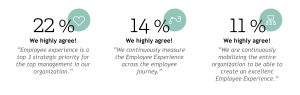
EX maturity is generally low. Only about one in five companies regard employee experience as a top-3 strategic priority, 14% of companies measure employee experience continuously, and 11% attempt to mobilize the company to be better at creating a good employee experience.
When companies have to define the strategic agenda, the primary focus is thus not directed at the employee experience but towards other areas, such as growth, product launch, costs, and customer experience, which have a clearer and more directly measurable effect on the top and bottom lines.
Financial Benefits when Focusing on Employee Experience
However, it does not need to be this way. There is an impressive amount of financial benefits to be reaped from prioritizing and focusing on employee experience.
The following 8 different dimensions affect the day-to-day top and bottom lines at your company:
-
Sickness absence - High absence increases direct costs and disrupts operations. Poor employee experience is often reflected in higher sick leave over time.
-
Staff outflow - When employees leave, organisations face recruitment costs, onboarding effort, and lost productivity. Turnover is one of the clearest financial signals of weak employee experience.
-
Attraction - Companies known for good employee experience find it easier to attract qualified candidates. A weak reputation increases hiring time and costs.
-
Retention of key employees -Losing high performers or specialists has a disproportionate impact on results. Strong employee experience helps retain critical skills and knowledge.
-
Onboarding speed - Effective onboarding enables new employees to become productive faster. Poor onboarding delays performance and increases early turnover risk.
-
Ability to innovate - Employees who feel engaged and supported are more likely to contribute ideas, collaborate, and challenge existing ways of working.
-
Productivity - Employee experience influences focus, motivation, and effort. Poor experiences lead to disengagement and lower output.
-
Rates of sale - Engaged employees tend to deliver better customer interactions, which directly affects sales performance and customer loyalty.
Connection Between Engagement and Profitability
Through analyses of many different companies, we have factually demonstrated the positive financial effects of putting employee experience in focus. For example, the analyses show time and again that there is a connection between an employee’s engagement and his/her ability to generate profitability.
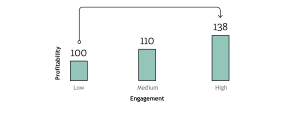
Source: anonymized Ennova case based on survey data with 45,000 employee responses
over three years combined with financial data
The example shows that employees with a high level of engagement deliver 38% more profitability than employees with low engagement.
We also see a direct effect on the bottom line. In a company with 16,500 employees and a churn rate of 7.5%, the costs associated with this are DKK 433 million a year, consisting of recruitment and onboarding costs as well as a temporary drop in productivity.

Want proof that EX impacts your bottom line?
Download our latest data on what drives engagement — and how it affects business results.
Being Best at Managing Employee Experience Generates Success
A comprehensive survey investigating the effect of a long-term focus on working with employee experience shows that organizations with a focus on employee experience have more than quadrupled their average profit and more than doubled their average turnover.
The financial effects of EX are therefore considerable. However, many organizations still struggle with fitting EX on the agenda, while lacking a systematic and practical approach to this discipline which could take employee experience to the next level.
With the book “Mastering Employee Experience” you get sound insight into the different disciplines and areas, showing you where and how you can start your organization’s EX transformation.
Curious about how you can work with employee experience? Get a free extract of the book “Mastering Employee Experience”.
|
See the Financial Impact of Employee Experience
If you want to understand how employee experience affects costs, productivity, and profitability in your organisation, we can help you assess the financial implications and identify where to focus.
|