/How%20to%20enhance%20leadership%20coaching%20with%20datadriven%20insights_Feature%20image_1200x700%20px.jpg?width=1080&name=How%20to%20enhance%20leadership%20coaching%20with%20datadriven%20insights_Feature%20image_1200x700%20px.jpg)
Data-driven leadership coaching combines coaching with insights from sources such as employee engagement surveys, leadership evaluations, and 360-degree feedback.
The data gives leaders and coaches an additional perspective on leadership behavior, helping them identify blind spots, prioritize development areas, and focus coaching conversations where they are most needed.
Data should not replace reflection, dialogue, or professional coaching judgment. Its value is to add structure and perspectives that the leader may not see alone, and to provide a basis for following development over time.
In this article, we explore how data can strengthen leadership coaching, what types of insights can be used, and how they can support more focused leadership development.
Jump to:
-
Leadership Coaching Provides the Context. Data Adds Another Perspective
- How to boost your organization with leadership coaching
- What is data-driven leadership coaching? Coaching with and without data
- The advantages of data-driven leadership coaching
- An example: How data can reveal new perspectives
Leadership Coaching Provides the Context. Data Adds Another Perspective
Leadership coaching gives leaders a structured space to reflect on their behavior, challenges, and development goals with a professional coach.
The limitation is that a coaching conversation may initially rely heavily on the leader’s own perception of the situation. Survey data, employee feedback, or leadership evaluations can add perspectives from the people who experience the leader’s behavior in practice.
This does not make the data the “truth.” Instead, it gives the coach and leader additional evidence to explore and discuss.
How to Boost your Organization with Leadership Coaching
It's important to remember that leaders are just people with emotions. They face immense pressures and challenges, and their personal growth is just as important as their professional development.
Recognizing this human aspect in leadership coaching helps create a supportive environment, fosters trust, and encourages leaders to wholeheartedly embrace change and development. By addressing both the emotional and professional needs of leaders, coaching becomes a more holistic and transformative experience.
Learn more about how you work with leadership development in our guide: From low scores to leadership success: How to support leaders with low engagement scores
|
What is Data-driven Leadership Coaching?
Data-driven leadership coaching combines coaching with quantitative and qualitative insights from sources such as employee surveys, leadership evaluations, and 360-degree feedback. These perspectives can help leaders and coaches identify patterns, explore potential blind spots, and focus the coaching process on relevant development areas.
Coaching With and Without Data
Coaching often starts with the leader’s own experiences, challenges, and perceptions, which the coach helps explore through reflection and dialogue. This can provide valuable insight, but it may not reveal how the leader’s behavior is experienced by others.
Data-driven coaching adds structured feedback from additional perspectives. Rather than treating the data as an objective truth, the leader and coach can use it as a starting point for exploring differences, identifying possible development areas, and deciding where to focus the coaching conversation.
The Advantages of Data-Driven Leadership Coaching
Adding structured data to leadership coaching can provide perspectives that might otherwise be difficult to identify. It can help leaders compare their own perception with how others experience their leadership, identify patterns worth exploring, and prioritize specific development areas.
Repeated measurements can also provide a basis for discussing how perceptions and leadership behaviors develop over time. The purpose is not to reduce leadership development to a score, but to use data as one input in an ongoing development process.
An Example: How Data Can Reveal New Perspectives
To see how structured feedback can add a new perspective to leadership coaching, consider a hypothetical example. An organization conducts a 360-degree leadership evaluation. One leader rates themselves 78 points on both “including others in decisions” and “delegating responsibility,” indicating that they see these as relative strengths.
However, feedback from peers and employees shows a different pattern, with scores ranging from 62 to 71 points. The difference does not necessarily mean that one perspective is right and the other is wrong. Instead, it highlights a potential gap between how the leader sees their own behavior and how that behavior is experienced by others.
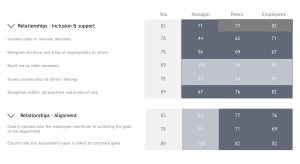
Results from a 360-degree evaluation showing the leader’s own scores (“You”) alongside feedback from peers and employees.
Without structured feedback, differences like these may take longer to surface in a coaching conversation. Bringing multiple perspectives into the process gives the leader and coach something concrete to explore together. They can discuss what may be behind the differences, identify possible blind spots, and decide whether changes in behavior are needed.
Differences between self-perception and how others experience a leader are one reason organizations use structured leadership feedback. Learn more about what a leadership development survey is and how it supports leadership development.