

Employee Experience: From Feedback to Measurable Impact
Employee experience shapes how people feel, perform, and grow at work.
From onboarding to everyday interactions, every stage of the employee journey influences engagement, retention, and performance.
 Understand what shapes employee engagement and retention
Measure what matters across the employee journey
Turn employee insights into action and lasting improvement

On This Page
- What is Employee Experience
- Why Employee Experience Matters
- Understanding the Employee Journey
- The 4 Key Drivers of Employee Experience
- How to measure Employee Experience
- Employee Experience Surveys
- From Feedback to Action
- Building an Employee Experience Strategy
- How to Improve Employee Experience
- Employee Experience in Practice
- What Is an Employee Experience Platform?
- FAQ About Employee Experience
What is Employee Experience?
Employee experience (EX) is the overall experience employees have with an organization throughout their working lives. It encompasses every interaction, process, and working condition that shapes how people feel about their workplace, from recruitment and onboarding to everyday work, career development, and exit.
Employee experience goes beyond individual moments. It is shaped by the entire employee journey, including how employees experience leadership, collaboration, communication, technology, and the organization's culture.
While employee experience describes what people encounter at work, employee satisfaction reflects how content they are with their job, and employee engagement captures how motivated, connected, and committed they feel. Understanding the differences between these concepts helps organizations look beyond satisfaction and engagement scores to identify the experiences that need attention.
Improving employee experience starts with understanding these experiences, identifying what matters most to employees, and making meaningful changes that support both people and organizational performance.
Why Employee Experience Matters
Employee experience is more than an HR priority. It influences how people engage with their work, whether they choose to stay, and how effectively organizations perform. When employees feel supported, have the right conditions to succeed, and trust their leaders, organizations are better positioned to build committed teams and deliver consistent results.
The business value of employee experience becomes clear across three important areas:
Stronger Employee Engagement and Retention
Positive workplace experiences help employees feel valued, motivated, and connected to their organization. When people experience meaningful work, supportive leadership, and opportunities to grow, they have more reasons to stay and contribute.
Understanding what drives employee engagement helps organizations identify potential challenges early and focus improvements where they matter most.
Better Performance and Business Outcomes
Employee experience shapes how effectively people work. Clear expectations, supportive leadership, strong collaboration, and the right tools help employees perform at their best.
These conditions can also improve productivity, customer interactions, and service quality, connecting employee experience to broader business outcomes.
A Stronger and More Resilient Organization
A positive employee experience helps build trust, collaboration, and a shared sense of direction, particularly during periods of organizational change.
By strengthening organizational culture and prioritizing employee well-being, organizations can create healthier working environments where employees feel supported and better equipped to navigate change.
Understanding the Employee Journey
Employee experience isn't created at a single point in time. It develops throughout the employee journey, from recruitment and onboarding to everyday work, development, career transitions, and exit.
Each stage brings different expectations, interactions, and opportunities to shape how employees experience the organization.
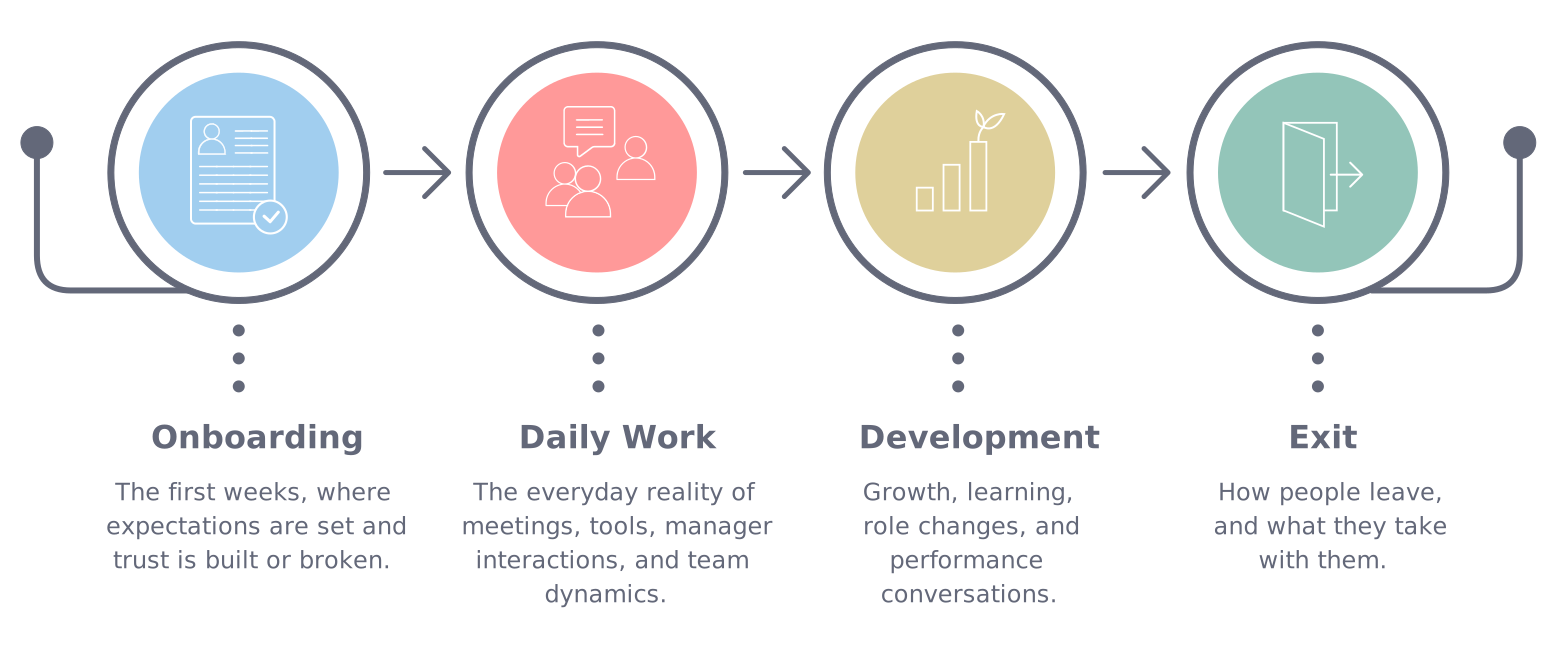
Focus on the Moments That Matter
Not every interaction has the same impact. Certain moments that matter, such as starting a new job, changing managers, receiving a promotion, or returning from leave, can strongly influence how employees feel about their workplace.
When these moments are handled well, they build trust, engagement, and connection. When they fall short, they can create frustration and weaken the overall employee experience.
Understanding these moments helps HR and leaders identify where employees need more support and where improvements can make the greatest difference.
By collecting feedback at key milestones through an Employee Lifecycle Survey, organizations can uncover friction, identify opportunities, and take targeted action to improve the employee journey.
The 4 Key Drivers of Employee Experience
Employee experience is shaped by many interconnected factors. Four areas play an important role in everyday working life: leadership, culture, work environment, and technology. Understanding how these factors work together helps organizations identify where improvements can make the greatest difference.
- 01 Leadership
- 02 Culture
- 03 Work Environment
- 04 Technology
Employee Experience Driver #1: Leadership
Direction, trust, psychological safety, communication, accountability, and follow-up all shape how employees experience leadership.Leaders set the tone for what's expected and what's possible. When leadership is clear and consistent, people know where they stand. When it isn't, uncertainty and mistrust can grow.
Employee Experience Driver #2: Culture
Shared norms, values, collaboration, inclusion, recognition, and everyday ways of working all shape the employee experience.
Culture isn't just what's written in the handbook. It's what people see rewarded, what gets ignored, and how decisions are made.
A strong organizational culture creates belonging and alignment. A weak culture can create confusion and inconsistency.
Employee Experience Driver #3: Work Environment
The work environment includes the physical, social, and organizational conditions that shape daily work. Workload, collaboration, team dynamics, flexibility, and access to support all influence how people feel and perform. These conditions also play an important role in employee well-being.
Employee Experience Driver #4: Technology
Tools, systems, and digital workflows shape how easily employees and managers can perform their work. When technology is difficult to use or unreliable, it creates friction and frustration in everyday work. The right technology removes unnecessary obstacles, supports collaboration, and makes work easier.
These drivers work together. Leadership influences culture. Technology shapes daily work. The work environment affects how people collaborate and perform. Improving employee experience means strengthening the system, not just fixing one part of it.
How to Measure Employee Experience
Employee experience is measured across the employee journey, not through a single score. The goal isn't just to collect feedback.
It's to understand where experience is strong, where it breaks down, and where action will have the greatest impact.
Where you Measure
Measure at the moments that matter across the employee journey, including onboarding, manager transitions, development, and exit.
Different moments reveal different challenges, which is why a single annual survey rarely tells the full story.
What you Measure
Use a mix of quantitative metrics and qualitative feedback. Two metrics carry most of the weight in:
- eNPS (Employee Net Promoter Score)
- Engagement Score
Together, they help explain both sentiment and commitment.
How you Measure
Measure consistently enough to compare across teams, regions, and time, but flexibly enough for local managers to act on the results. The strongest EX programs balance shared direction with local ownership. And they treat measurement as a starting point for action, not an end goal.
Where you Measure
Measure at the moments that matter across the employee journey, including onboarding, manager transitions, development, and exit. Different moments reveal different challenges, which is why a single annual survey rarely tells the full story.
What you Measure
Use a mix of quantitative metrics and qualitative feedback. Two metrics carry most of the weight in:
- eNPS (Employee Net Promoter Score)
- Engagement Score
Together, they help explain both sentiment and commitment.
How you Measure
Measure consistently enough to compare across teams, regions, and time, but flexibly enough for local managers to act on the results. The strongest EX programs balance shared direction with local ownership. And they treat measurement as a starting point for action, not an end goal.
Employee Experience Surveys
Employee surveys help organizations understand how people experience their workplace, what drives engagement, and where improvements are needed.
But different surveys serve different purposes. Combining broad engagement measurement with targeted feedback throughout the employee journey provides a more complete understanding of employee experience.
Four Survey Types That Support Employee Experience Programs
Employee Engagement Surveys
Engagement surveys measure employees' motivation and commitment alongside the factors that influence them, such as leadership, recognition, development, and trust.
Typically conducted once or twice a year, an Employee Engagement Survey establishes a consistent baseline, highlights strengths and challenges, and helps organizations prioritize meaningful improvements.
Pulse Surveys
Pulse surveys are short, focused check-ins used between larger engagement surveys. They help organizations track specific themes, follow up on areas needing attention, and assess whether previous actions are making a difference.
Used alongside broader measurement, Pulse Surveys keep employee feedback connected to ongoing improvement.
Employee Lifecycle Survey
Employee lifecycle surveys capture feedback at key moments, including onboarding, role changes, manager transitions, development, and exit.
An Employee Lifecycle Survey complements broader engagement measurement by revealing how specific moments shape the employee experience and where improvements are needed throughout the employee journey.
360° and Leadership Feedback
A Leadership Development Survey gathers feedback on leadership behavior from multiple perspectives, including employees, peers, and managers.
It helps leaders understand how their behavior is experienced by others, identify strengths and development opportunities, and focus their efforts where they can make the greatest difference.
From Feedback to Action
Collecting employee feedback is only the beginning. The real challenge is turning insights into meaningful improvements. When employees share their experiences but see little response, trust in the process can weaken, and future feedback becomes less valuable.
Turning feedback into action requires clear priorities, meaningful conversations, and consistent follow-up that employees can see and experience.
Why Employee Surveys Fail to Drive Change
Even a well-designed employee survey can fall short if the organization lacks a clear approach to what happens next. Five common barriers prevent valuable insights from becoming meaningful improvements.
The Data Lands Without a Plan
Results are shared, dashboards are updated, but no one is clear on what to prioritize, who should act, or what happens next.
Managers get Insight, but not Enough Direction
Scores and dashboards are not enough. Managers need guidance to interpret results, understand what matters most, and turn feedback into productive team conversations.
Senior Leaders do not set Clear Priorities
Without clear direction from leadership, teams risk spreading their efforts across too many initiatives instead of focusing on the improvements that matter most.
Local Context Gets Lost
Organization-wide results can hide important differences between teams, functions, and markets. Effective follow-up requires understanding the challenges and opportunities within each team.
Follow-up Disappears
Employees share their feedback but hear little about what happens afterward. Without visible progress or communication, confidence in future surveys can decline.
When these barriers persist, employee surveys become a recurring exercise rather than a driver of improvement. Addressing them requires clear ownership, focused priorities, and a consistent approach to follow-up.
What It Takes to Turn Feedback Into Action
Turning feedback into action requires more than surveys and dashboards.
It requires clear ownership, manager support, leadership accountability, and visible follow-up.
Five of Those Conditions Matter Most
A clear process for how feedback moves from collection to decision to follow-up. Who reviews what, when, and with which mandate to act. Without governance, even good intentions get lost in calendars.
Someone must own what happens next. HR owns the process. Leaders own the priorities. Managers own the dialogue. Without clear ownership, action stalls.
Managers play a key role in employee experience. They need more than a report: they need a clear understanding of what the data means, where they can make the biggest impact, and how to turn feedback into team dialogue and action.
Senior leaders set the tone for whether feedback matters. When they engage with the results, choose priorities, and follow up publicly, the organization listens. When they don't, the rest of the system stalls.
People don't expect everything to be solved. They expect to know that they were heard, what's being done, and what they should expect next. Communicating action (even small action) is what rebuilds trust between rounds of feedback.
The Shift from Feedback to Action
Most organizations are good at listening. What they struggle with is what happens next.
The strongest employee experience programs make a deliberate shift:
- From reporting on feedback to acting on it
- From measuring engagement to improving it
- From "we ran the survey" to "we changed something because of it"
When organizations combine employee insights with clear ownership, focused action, and consistent follow-up, feedback becomes more than a measurement exercise. It becomes a foundation for continuous improvement and stronger organizational performance.
How Do You Build an Employee Experience Strategy?
Knowing what employee experience is and why it matters is one thing. Building a strategy that improves how people experience work requires clear priorities, ownership, and consistent follow-through.
A strong employee experience strategy provides a clear plan for how your organization will measure, improve, and continuously manage employee experience over time.
A Simple Framework for a Strong Employee Experience Strategy
An effective employee experience strategy starts with three fundamental questions: Where are you today, where do you want to go, and how will you get there?
-
Where You Are
Establish a clear baseline of how employees currently experience your organization. Identify what works well, where challenges exist, and which experiences have the greatest potential for improvement. -
Where You're Going
Define a focused set of priorities that align employee needs with your business strategy and organizational ambitions. Rather than trying to improve everything, concentrate on the areas that matter most. -
How You'll Get There
Create a roadmap with clear responsibilities, measurable goals, and a consistent approach to listening, action, and follow-up. The strategy should translate into improvements employees can experience in their daily work.
A Roadmap for the First Year and Beyond
Improving employee experience takes time. A structured roadmap helps organizations establish a strong foundation, translate insights into action, and build a continuous cycle of measurement and improvement.
The following phases provide a practical starting point
0–3 Months: Establish the Foundation
-
Define what employee experience means for your organization.
-
Map existing employee listening channels.
-
Identify key moments across the employee journey.
-
Clarify ownership across HR, senior leadership, and managers.
-
Establish a baseline of the current employee experience.
3–12 Months: Turn Insights into Action
-
Prioritize the drivers and moments that matter most.
-
Equip managers to interpret results and lead meaningful team conversations.
-
Establish local action planning and follow-up routines.
-
Strengthen leadership accountability.
-
Communicate priorities, actions, and progress to employees.
12+ Months: Embed Continuous Improvement
-
Connect engagement, employee lifecycle, pulse, and leadership feedback.
-
Use benchmarks and trends to refine priorities.
-
Strengthen governance and organizational ownership.
-
Track progress and evaluate the impact of improvement initiatives.
-
Continuously improve the moments that matter.
The first phase establishes the foundation. The second turns insights into action. The third embeds employee experience into the organization's ongoing way of working.
Employee experience is never finished. Sustainable improvement requires organizations to revisit priorities, measure progress, and adapt as employee needs and business conditions evolve.
Who Owns What in an Employee Experience Strategy?
Employee experience cannot be owned by HR alone. Successful implementation requires clear responsibilities across the organization, with everyone contributing to a shared direction. When everyone understands their role and takes ownership, organizations are better equipped to turn their EX strategy into meaningful, lasting improvements.

HR and People Teams
HR owns the overall framework, including how employee feedback is collected, how results are communicated, and how leaders and managers are supported in turning insights into action.

Senior Leadership
Senior leaders set the strategic direction, establish priorities, and ensure the resources and accountability needed to drive meaningful improvements across the organization.

Managers
Managers turn employee insights into team conversations, identify improvements, and follow up on agreed actions. Effective leadership development helps them translate feedback into better everyday experiences.

Employees
Employees provide feedback, share their experiences, and contribute to identifying and implementing improvements. Their involvement helps ensure that actions address real needs and challenges.
How Ennova Supports Your Strategy
Ennova helps enterprise organizations turn employee experience strategies into consistent action across teams, business units, and markets.
We combine research-based measurement, relevant benchmarks, and expert guidance to help organizations identify priorities, structure effective employee listening programs, and drive meaningful improvements.
Our in-house advisors support strategy and follow-up, dedicated success managers help ensure effective implementation, and our leadership development expertise helps leaders turn employee insights into everyday improvements.
Together with our People Impact Platform, these capabilities provide the insights, expertise, and support needed to put your employee experience strategy into practice.
Why Ennova?
✓ Research-based EX measurement and relevant benchmarks.
✓ In-house advisory expertise for listening strategies and follow-up.
✓ Dedicated success management and implementation support.
✓ Leadership development to turn insights into meaningful improvements.
How Do You Improve Employee Experience?
Improving employee experience isn't about adding more programs. Most organizations already have initiatives in place. The goal is to focus on the changes that matter most to employees and improve how work feels day to day.
Four Principles Guide the Strongest Improvement Work:
1
Identify the Real Problem Before Solving it
One of the biggest risks in employee experience work is solving the wrong problem. Leaders may focus on issues they assume are causing frustration, while employee feedback points elsewhere. Combine survey data with team conversations to understand the root causes before deciding what to change.
2
Equip Managers to act on Feedback
Managers play a central role in employees' everyday experiences. Senior leaders set the direction, but managers bring it to life through clear expectations, constructive conversations, and consistent follow-up. Effective leadership development helps managers turn feedback into practical improvements.
3
Improve the Moments with the Highest Impact
You can't fix everything at once, and you shouldn't try. Focus on the moments that matter, such as onboarding, manager transitions, or returning from leave, where targeted improvements can make the greatest difference to employee experience.
4
Remove Barriers that Make Work Harder
Poor employee experience often stems from everyday friction: complicated tools, slow processes, unclear responsibilities, or ineffective onboarding. Removing these obstacles can improve daily work without adding another initiative.
Trust isn't built by collecting feedback alone. It's built by showing what happens next.
Employees don't expect every issue to be solved immediately. But clear communication, visible progress, and consistent follow-up demonstrate that their feedback matters.
How Danish Crown Turns Employee Feedback Into Continuous Improvement
With approximately 25,000 employees across multiple countries and production sites, Danish Crown needed a consistent approach to understanding employee experiences and supporting ongoing improvements.Since 2007, the company has worked with Ennova to track employee satisfaction, motivation, and leadership feedback through regular employee engagement surveys.
.

88% Employee Survey Participation
Danish Crown achieved an 88% response rate in its 2024 employee engagement survey.
Danish Crown achieved an 88% response rate in its 2024 employee engagement survey.
Across four survey rounds, the company also reported continuous improvement in satisfaction and motivation among hourly-paid employees and halved the proportion of managers with low scores.
These results reflect Danish Crown's long-term commitment to systematic employee listening, leadership development, and continuous improvement.

What is an Employee Experience Platform?
An employee experience platform (EX platform) helps organizations collect and understand employee feedback across the employee journey and turn insights into meaningful improvements.
While basic survey tools primarily focus on collecting feedback and reporting results, a more comprehensive EX platform connects employee listening, analytics, action planning, and follow-up. This gives HR, leaders, and managers a more complete understanding of employee experience and helps them identify where improvements can make the greatest difference.
What to Look for in an Employee Experience Platform
The right platform should do more than collect feedback.
It should help your organization understand employee experiences, identify priorities, and support meaningful action.
Five capabilities are particularly important:
Collect feedback at key stages of the employee journey, from onboarding and development to exit, using engagement, pulse, lifecycle, and leadership surveys.
Give managers clear, team-level insights, relevant benchmarks, and recommendations they can use to prioritize improvements.
Support meaningful team conversations, action planning, and consistent follow-up rather than simply reporting survey results.
Ensure strong data protection, accessibility, security, and integrations that fit your organization's existing systems and requirements.
Use AI to uncover patterns, simplify analysis, and support better decisions while maintaining transparency and human oversight.
More about Thoughtful AI
How Ennova Turns Employee Insight Into Action
Improving employee experience requires more than collecting feedback. It takes a clear understanding of what matters, focused priorities, and the ability to turn insights into meaningful change. Ennova combines research-based measurement, advanced analytics, and human expertise to help organizations move from feedback to action. Our People Impact Platform brings these capabilities together, helping HR, leaders, and managers make informed decisions and drive continuous improvement.
Listen Across the Employee Journey
Connect engagement, lifecycle, pulse, and leadership feedback to understand employee experiences across teams and throughout the employee journey.
Focus on What Matters Most
Use advanced analytics and relevant benchmarks to understand what drives engagement. AI-powered team insights highlight the three priority areas with the greatest potential for improvement.
Turn Insights Into Action
Equip managers with clear insights and practical guidance to support team conversations, focused action, and consistent follow-up.
FAQ About Employee Experience
Employee experience influences how employees feel about work and can affect engagement, retention, collaboration, and organizational performance.
By understanding and improving everyday workplace experiences, organizations can reduce friction, strengthen employee engagement, and create better conditions for both people and business success.
Employee experience describes the overall experience employees have throughout their working lives, including leadership, culture, processes, and everyday interactions.
Employee engagement reflects how motivated, connected, and committed employees feel, while employee satisfaction describes how content they are with their work and working conditions.
Understanding the differences between these concepts helps organizations measure what matters and identify opportunities for improvement.
Employee experience is shaped by many interconnected factors. Four important areas are leadership, organizational culture, work environment, and technology.
Leadership influences trust and communication, culture shapes how people collaborate, working conditions affect well-being, and technology influences how effectively employees can perform their work.
Understanding how these factors interact helps organizations identify where improvements can make the greatest difference.
Psychological safety means employees feel able to speak up, ask questions, share ideas, and raise concerns without fear of negative consequences.
It supports open communication, trust, and collaboration. When employees feel psychologically safe, they are more likely to share honest feedback and contribute to improvements.
Creating psychological safety is an important part of building a supportive work environment and strengthening leadership effectiveness.
An Engagement Score summarizes employees' motivation, commitment, and connection to their organization based on survey responses.
It helps HR and leaders track engagement over time and identify areas that need attention.
However, the score alone doesn't explain what drives engagement. Understanding the underlying factors, employee feedback, and team context is essential for turning results into meaningful action.
Employee experience surveys help organizations understand how employees experience their workplace and identify opportunities for improvement.
Common types include engagement surveys for measuring motivation and commitment, pulse surveys for focused check-ins, employee lifecycle surveys for feedback at key moments, and 360° surveys for leadership development.
Combining different survey types provides a more complete understanding of employee experience across the employee journey.
Ready to Take Action?We are Empowering.
See how Ennova helps you listen, understand, decide, act, and improve.