/How-ESG-Sustainability-Elevate-Customer-Experience-1200x60.jpg?width=1080&name=How-ESG-Sustainability-Elevate-Customer-Experience-1200x60.jpg)
ESG can influence customer experience, but not every environmental, social or governance issue matters equally to every customer. The challenge is to understand which ESG topics customers value, how they perceive your current performance and where expectations are not being met.
Customer feedback can help you identify these gaps. By comparing how important different ESG dimensions are to customers with how they perceive your performance, you can prioritize the areas that are most relevant to the customer experience and turn insights into focused action.
In this article, we explore how to use customer insights to identify ESG priorities, translate them into customer experience actions and monitor how expectations change over time.
New to the topic? Start with our guide to what ESG means in customer experience.

From ESG Insights to Customer Impact
ESG only creates value when it improves customer experience.
Jump to:
- Why Customer Insights Matter in ESG
- Understand Which ESG Issues Matter to Your Customers
- Use Importance and Performance to Identify ESG Priorities
- Turn ESG Insights Into Customer Experience Actions
- Communicate ESG Progress With Credibility
- Monitor How Customer Expectations Change
Why Customer Insights Matter in ESG
ESG priorities can look very different depending on the customer, market and industry. An environmental issue may be highly relevant in one customer relationship, while social or governance factors may matter more in another.
That is why organizations should not assume which ESG topics matter most to customers. Customer feedback can help identify where ESG expectations are particularly relevant to the customer experience and where closer attention may be needed.
Understand Which ESG Issues Matter to Your Customers
Start by identifying which environmental, social and governance topics are relevant to your customers. Surveys, interviews and other customer feedback can help you understand which issues customers consider important and whether priorities differ between customer groups or markets.
The objective is not to let customer preferences determine your overall ESG obligations or strategy. Instead, customer insights help you understand where ESG intersects most clearly with the customer experience.
Use Importance and Performance to Identify ESG Priorities
Once you understand which ESG topics are relevant to customers, the next step is to compare two perspectives:
Importance: How important is the ESG topic to the customer experience?
Perceived performance: How well do customers think the organization performs on that topic?
Comparing importance with perceived performance can help identify where customer expectations and perceptions are aligned and where meaningful gaps may exist.
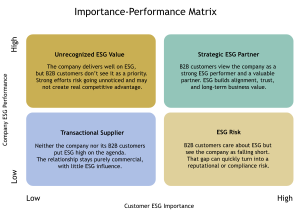
High importance + low perceived performance: A potential priority for further investigation and action.
High importance + high perceived performance: An area where customer expectations and perceived performance are well aligned.
Low importance + high perceived performance: Strong perceived performance, but potentially lower relevance to the customer experience.
Low importance + low perceived performance: Potentially a lower CX priority, although other ESG, regulatory or business considerations may still make the topic important.

Ready to Act on What the Data Reveals
Learn how to uncover what matters most to your customers and turn insights into action.
Turn ESG Insights Into Customer Experience Actions
Identifying an ESG gap is only the starting point. The next step is to understand what is behind the gap and translate the insight into improvements that customers can actually experience.
1. Focus on the Most Relevant Gaps
Start with ESG topics that customers consider important and where perceived performance is comparatively low. These areas may deserve closer investigation because they indicate a gap between customer expectations and how the organization is currently perceived.
Customer priorities should not determine whether an organization fulfills ESG, regulatory or ethical obligations. The purpose of the analysis is to identify where ESG is particularly relevant to the customer experience.
2. Understand What Is Behind the Gap
Do not treat a low score as the diagnosis. Use qualitative feedback, interviews, open-ended survey responses and relevant internal ESG data to understand why customers perceive performance differently from their expectations.
This can help distinguish between an actual performance issue, a customer experience problem and a communication gap.
3. Translate ESG Priorities Into Customer Experience Improvements
Connect the insight to the parts of the customer journey where customers encounter the issue. Depending on the finding, action might involve changing a product or service, improving a process, making information easier to understand or addressing inconsistencies between what the organization communicates and what customers experience.
4. Create Clear Ownership
Assign responsibility for each priority and define what needs to change. ESG-related customer experience issues often cross organizational boundaries, so CX teams may need to work with sustainability, operations, communications, product teams or other relevant functions.
Focus on a manageable number of priorities rather than trying to address every ESG dimension at once.
Communicate ESG Progress With Credibility
How organizations communicate ESG progress is part of the customer experience. Claims should reflect what the organization can document and should be clear about both progress and limitations.
Use customer insights to understand where expectations are unclear or where communication does not match customer perceptions. At the same time, support customer-facing claims with relevant internal ESG data to reduce the risk of overstating performance.
Credible ESG communication is not about presenting perfect progress. It is about making clear, evidence-based claims that customers can understand and evaluate.
Monitor How Customer Expectations Change
Customer expectations around ESG can change over time and may differ between customer groups, markets and touchpoints. What matters today may not have the same relevance in the future.
Continue listening to customers and track both importance and perceived performance over time. This can help you identify emerging expectations, evaluate whether actions are changing customer perceptions and adjust priorities when needed.
Keep the measurement approach as consistent as possible when comparing results over time so that changes are easier to interpret.