
HR functions in more and more organisations have begun working with people analytics as a way to make HR more data-driven and to connect people-related decisions more closely to business results.
People analytics can be used in many areas. In this article, we focus on one specific and often underestimated structural decision: span of control and how data can help organisations understand its impact before changes are made.
|
Go to: |
People analytics is many different things and can do many different things. I will just address one of the many areas where HR analyses can move the company from one level to the next.
What Span of Control Is and Why It Matters
Imagine an organisation that wants to reduce the number of managers in order to create a flatter and more agile structure, while also cutting costs by lowering management expenses.
In practice, this means changing the span of control: how many employees each manager is responsible for.
Adjusting span of control can be a reasonable decision. However, it also raises an important question: what consequences does this change have for employees, managers, and overall performance?
This is where HR data can play a crucial role by providing insight that helps top management make better-informed decisions.
Research the Consequences Upfront
One immediate consequence of increasing span of control is obvious: managers will be responsible for more employees.
What is less obvious is how this affects employee well-being, engagement, and productivity — and ultimately the organisation’s top and bottom lines.
At Ennova, we have analysed span of control across more than 12,000 teams worldwide. These analyses show clear patterns:
- As span of control increases, employee assessments of both immediate managers and top management decline.
- Larger team sizes are associated with lower engagement and a lower willingness to recommend the organisation as a workplace (eNPS).
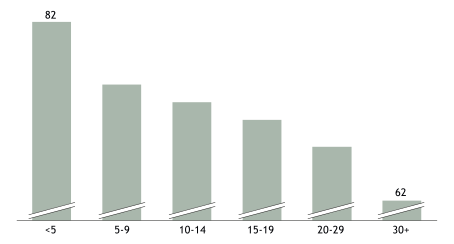
Span of Control
Uncover the More Complex Links
When looking more closely at the data, the picture becomes more nuanced.
Some managers are able to handle a relatively large span of control. For example, in several organisations we have seen managers in customer-facing units successfully supervise more than 15 employees while maintaining high engagement and positive evaluations.
In contrast, certain employee groups — such as high-potential talents — tend to thrive in teams with a smaller span of control. These employees often need more frequent feedback and closer support, which naturally limits how many direct reports a manager can reasonably oversee.
Organisational context also matters. Some companies are simply better equipped to support larger teams because managers have the skills, tools, and structures needed to lead effectively at scale.

Use Data to Design Smarter Organizations
Learn how to uncover the right span of control and boost efficiency with people analytics.
There is a Strong Business case for Span of Control Analyses
Analyzing span of control within the specific context of an organization provides valuable insight into employee engagement, a factor that directly affects business performance.
Global analyses consistently show that lower engagement is associated with a higher risk of voluntary turnover. When employees leave, particularly key employees or talents, the organization incurs significant costs related to recruitment, onboarding, and lost productivity.
Span of control analyses therefore make sense not only from an HR perspective, but also as a people analytics initiative that links organizational structure directly to business outcomes.
Why There Is No Single “Right” Span
There is no single optimal span of control that applies to all organisations. Context is critical. Factors such as manager capabilities, employee seniority, team composition, and the level of self-management all influence how many employees a manager can effectively support.
Because these conditions vary across organisations, and even across teams, all companies benefit from analysing their own span of control. Only by understanding their specific context can organisations optimise leadership capacity, employee engagement, and performance.
Get in touch with usReady to Strengthen Your Employee Experience?
Our experts are ready to help you and your organization collect the right data and turn it into action. From survey setup to consulting, we're with you every step of the way.
|